
The short answer
A leveraged buyout uses debt to reduce the buyer’s equity cheque. That can multiply the equity return—but it also makes a forecasting error much harder to survive.
Hilton and TXU make the contrast vivid. Both were enormous 2007 buyouts. Hilton changed its operating model, returned to public markets and gave its owners several routes to monetise. TXU’s successor entered bankruptcy after a heavily levered capital structure met a thesis that did not hold.
The useful question is not “Did the deal use leverage?” It is “What produced the return, and what remains if the optimistic assumptions disappear?”
Transaction values are not interchangeable. This article labels equity consideration, assumed debt, acquisition costs and total transaction value where primary records allow. Sponsor-level realised returns are not stated unless the underlying cash flows are public.
01 · LBO meaning and mechanics
Debt makes the equity claim smaller—and more volatile.
In a leveraged buyout, a sponsor acquires control using its own equity alongside acquisition debt. The borrower, guarantors and collateral vary by deal, but the acquired company’s assets and future cash flows usually support the financing.
| Purchase financing | Amount | Claim |
|---|---|---|
| Sponsor equity | ₹400 crore | Residual upside and first loss |
| Acquisition debt | ₹600 crore | Senior contractual claim |
| Enterprise value bought | ₹1,000 crore | Value of the operating business |
The sponsor controls a ₹1,000 crore business after contributing ₹400 crore. The missing ₹600 crore has not been created; creditors provided it and rank ahead of equity. If business value rises, a smaller equity base can produce a larger percentage gain. If value falls, equity absorbs the decline first.
02 · A worked LBO model
Enterprise value grows 1.4×. Sponsor equity grows 2.75×.
Assume the business is sold after five years for ₹1,400 crore and cumulative free cash flow has reduced debt from ₹600 crore to ₹300 crore. Exit equity value is ₹1,100 crore: enterprise value less debt.
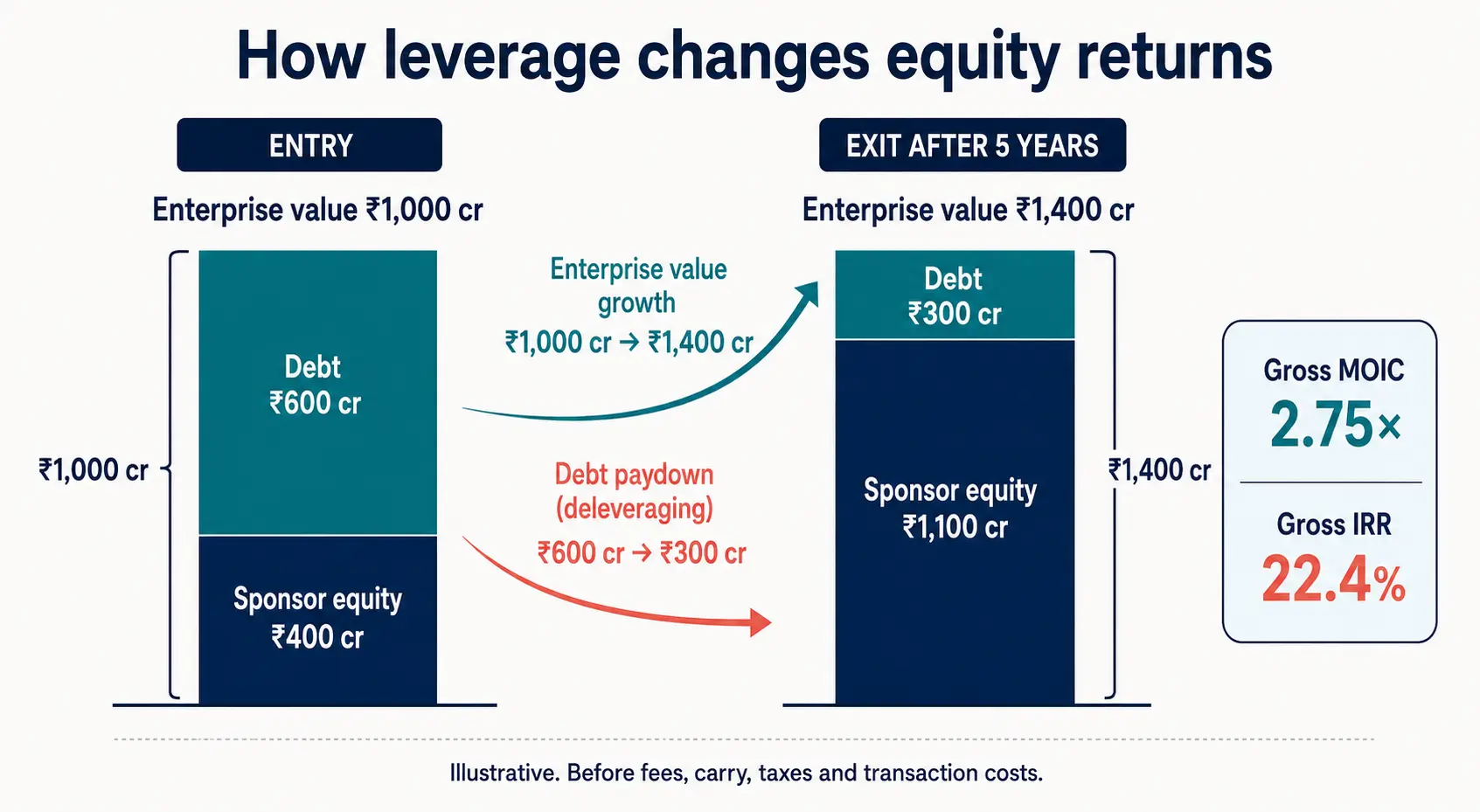
The business itself did not compound at 22.4%. The sponsor’s equity did, because debt fell while enterprise value rose. The same arithmetic reverses when enterprise value contracts.
| Five-year exit scenario | Exit EV | Debt | Equity value | Gross MOIC | Gross IRR |
|---|---|---|---|---|---|
| Stress | ₹800 cr | ₹500 cr | ₹300 cr | 0.75× | -5.6% |
| Deleveraging only | ₹1,000 cr | ₹300 cr | ₹700 cr | 1.75× | 11.8% |
| Illustrative base | ₹1,400 cr | ₹300 cr | ₹1,100 cr | 2.75× | 22.4% |
AssetsNest calculation. The model deliberately excludes interim distributions, transaction fees, management fees, carried interest and tax.
03 · Where LBO returns come from
Five return drivers—only two are fully under the operator’s influence.
EBITDA growth
Revenue, pricing or volume lifts earnings. At an unchanged valuation multiple, higher EBITDA increases enterprise value.
Margin and cash conversion
Procurement, working capital and productivity can create value. Cutting productive investment merely borrows from the future.
Debt paydown
Free cash flow reduces the senior claim. Equity can rise even if enterprise value is unchanged.
Multiple change
Buying at 8× EBITDA and selling at 10× helps. It is also exposed to rates, market mood and comparable-company valuations.
Distributions
Dividends or a leveraged recap return cash before exit. Early proceeds may lift IRR while adding financial risk to the company.
A high LBO IRR is a result. It is not, by itself, proof of exceptional operating performance.
Professional attribution asks how much came from earnings growth, debt reduction, multiple expansion, distributions and time. A sponsor can report an attractive IRR after a short hold even when the money multiple is modest. Use the AssetsNest IRR vs MOIC guide to separate speed from total value.
04 · Nine real LBO lessons
The case atlas: same technique, radically different outcomes.
These cases are not ranked and they are not treated as clean morality tales. Each isolates one underwriting question that a headline transaction value cannot answer.
Hilton: operations overcame hostile timing
$26bn transaction · announced July 2007Blackstone bought Hilton just before the financial crisis damaged travel and credit markets. The recovery was not simply a rebound in hotel property values. Hilton expanded an asset-light management and franchise system, returned to public markets in 2013 and used private ownership to change the business beneath the capital structure.
Lesson: a bad entry year is survivable when the operating model improves enough and liquidity lasts long enough.TXU: leverage magnified a broken forecast
$31.5bn new debt · $8.3bn sponsor/co-investor equityThe 2007 TXU acquisition placed a large fixed claim against cash flows exposed to energy-market assumptions. Energy Future Holdings later entered bankruptcy. The crucial point is not that every forecast was unreasonable; it is that small errors became existential because the equity cushion was thin relative to the debt stack.
Lesson: an LBO leverages the accuracy of the investment thesis, not only the balance sheet.Toys “R” Us: disruption met financial rigidity
$6.6bn transaction plus assumed debt · 2005The retailer faced e-commerce pressure, changing consumer behaviour and an operating model that needed investment. Debt did not create every commercial problem. It did make cash more contested: interest and refinancing competed with stores, fulfilment, technology and experimentation. The company filed Chapter 11 in 2017 and sought to close its remaining 744 U.S. stores in 2018.
Lesson: leverage is most dangerous when a weakening business must spend heavily to reinvent itself.HCA: cash-flow visibility can support debt
$33bn including $11.7bn debt assumed or repaid · 2006HCA’s recurring demand and substantial cash generation made its debt capacity different from that of a volatile retailer or commodity-linked business. It later returned to public markets. Healthcare is not low-risk—reimbursement, regulation and labour costs matter—but lenders could underwrite a more visible stream of operating cash.
Lesson: leverage should be calibrated to cash-flow volatility, not to a sponsor’s desired equity return.Caesars: map the borrower, not just the group
$30.7bn including assumed debt and costs · 2008Harrah’s, later Caesars, showed how creditors in the same corporate family can hold very different claims. Operating companies, property entities, guarantees and collateral packages determine where cash can move and who recovers first. A group-level debt number hides those distinctions.
Lesson: in distress, legal entity, collateral, guarantee and cash-transfer rules are economic facts.Dell: an exit can be a sequence
2013 take-private · EMC in 2016 · VMware spin-off in 2021Michael Dell and Silver Lake took Dell private, then completed the much larger EMC acquisition, using a VMware-linked tracking stock as part of the consideration. Dell later re-entered public markets through the Class V transaction and spun off its VMware stake. There was no single clean ‘sell’ date.
Lesson: strategic optionality can create value, but investors must trace cash, retained stakes and debt across every step.Heinz: the capital instrument changes the return
$8bn Berkshire preferred stock · 9% annual dividendBerkshire Hathaway and 3G did not hold identical plain-vanilla common equity. Berkshire’s preferred stock had a 9% annual dividend, adding a contractual return layer before Heinz combined with Kraft. The public merger became another stage of ownership, not a conventional full exit.
Lesson: headline ownership is incomplete without the security’s priority, coupon, conversion and redemption rights.PetSmart and Chewy: the best asset arrived later
Chewy acquired in 2017 · IPO in 2019PetSmart acquired Chewy after the sponsor buyout. Chewy then listed publicly while PetSmart and BC Partners-affiliated holders retained control. Much of the strategic option value came from an asset that was not in the original buyout perimeter.
Lesson: separate value bought at entry from value built, acquired or financed later.Medline: listing is not the same as exit
$29 IPO price · trading began December 2025Blackstone, Carlyle and Hellman & Friedman invested in Medline in 2021 while the company remained family-led. Medline’s 2025 IPO raised public capital and established a market price, but pre-IPO owners remained important shareholders. The listing created liquidity; it did not prove that every sponsor dollar had been realised.
Lesson: distinguish an IPO, a secondary sale and a sponsor’s final cash exit.05 · LBO exit strategies
An IPO is a liquidity event. A final exit is a cash-flow fact.
| Route | What happens | What investors should verify |
|---|---|---|
| IPO | Shares begin trading publicly | Primary vs secondary proceeds, retained stake and lock-ups |
| Strategic sale | An operating buyer acquires the company | Synergies, conditions, earn-outs and assumed liabilities |
| Secondary buyout | One sponsor sells to another | Why another owner can create value after a second entry price |
| Recapitalisation | New debt refinances old debt and may fund a dividend | Cash returned versus leverage left behind |
| Strategic combination | The company merges into a broader platform | Security received, governance and continuing exposure |
| Restructuring or liquidation | Claims are exchanged, extended, impaired or assets sold | Entity, collateral, priority, recovery and time |
Dell, Kraft Heinz and Medline show why the familiar “buy, improve, sell” sequence is often too tidy. Ownership can be monetised through several transactions over many years.
06 · Professional underwriting
Start with survival. Then model the target IRR.
The wrong opening question is “Can this deal earn 25%?” The better opening question is “What happens if EBITDA falls 20%, interest stays high, the refinancing window closes and the exit multiple contracts?”
Do not stress one variable at a time. In a real slowdown, EBITDA, cash conversion, refinancing cost and valuation often deteriorate together.
07 · India relevance
In India, “buyout” and “LBO” are not automatic synonyms.
India has a deep control-investment market, but a classic U.S.-style target-company LBO cannot simply be copied across jurisdictions. Takeover rules, listed-company requirements, acquisition-financing restrictions, foreign-investment rules, tax and the ability to move cash between entities can change the structure materially.
Blackstone’s 2016 Mphasis transaction is a useful example of control being acquired through a share-purchase agreement and an open offer. The SEBI letter of offer records an agreement covering up to 60.17% of expanded equity capital and an open offer for 26% to public shareholders. That is a control buyout; the document does not make it a textbook U.S.-style target-funded LBO.
For an Indian transaction, investors should verify the current Companies Act, SEBI, RBI, FEMA, tax and sector-specific position with qualified advisers. The legal borrower and source of debt service are part of the investment economics, not back-office detail.
08 · LBO underwriting checklist
Twenty questions before accepting the headline return.
- 01What were entry enterprise value, equity value and EBITDA multiple?
- 02How much cash equity did the sponsor actually invest?
- 03How much new debt was raised, and where does it sit?
- 04Which debt pays cash interest, and which accrues PIK?
- 05How much covenant and interest-coverage headroom exists?
- 06How much maintenance capex is required to protect cash flow?
- 07How does reported EBITDA reconcile to free cash flow?
- 08Which maturities fall inside the holding period?
- 09What happens if refinancing markets close for two years?
- 10What share of expected return comes from EBITDA growth?
- 11What share comes from debt paydown?
- 12Does the model require multiple expansion?
- 13Can the business tolerate a 20% EBITDA decline?
- 14Which creditors hold collateral and guarantees?
- 15Are valuable assets structurally outside a borrower?
- 16Can cash legally move between entities?
- 17Has the sponsor already received dividends or recap proceeds?
- 18Which buyers can realistically own the business at exit?
- 19What if exit is delayed by three years?
- 20What remains for equity in the combined downside case?
Conclusion
The business must be strong enough to protect the capital when the model is wrong.
Hilton, TXU and Toys “R” Us show the same principle from different directions. Debt magnifies the consequences of operating performance, entry valuation, cash conversion and time.
The strongest buyouts combine genuine business improvement, cash generation, measured deleveraging, strategic optionality and more than one viable exit. The weakest require one favourable forecast to continue indefinitely.
If the optimistic assumptions disappear, is there still enough business underneath the leverage?Frequently asked questions
Leveraged buyouts, returns and risk
What is a leveraged buyout in simple terms?
A leveraged buyout is a control acquisition funded with sponsor equity and substantial borrowing. The acquired business normally supports the debt through its assets and future cash flow. Debt reduces the sponsor’s initial equity cheque, but makes that equity more sensitive to every change in business value.
How does an LBO make money?
Equity value can grow through higher EBITDA, better margins and cash conversion, debt repayment, a higher exit multiple and cash distributions. A credible underwriting case identifies each source separately instead of calling the entire return operational improvement.
Who repays the debt in an LBO?
The acquired company’s cash flows usually service the acquisition financing, subject to the actual legal structure, guarantees and borrowing entities. That is why free cash flow, interest coverage, maturity dates and the ability to refinance matter so much.
What is the difference between MOIC and IRR in an LBO?
MOIC measures how many units of value are received for each unit invested. IRR also reflects time. Two deals can both return 2.0×, but the one returning cash in three years has a higher IRR than the one taking seven years.
Is every private-equity acquisition an LBO?
No. Growth equity and some control investments use little acquisition leverage. Private equity, buyout and leveraged buyout are related terms, but they are not interchangeable.
Can a classic US-style LBO be copied in India?
Not automatically. Indian takeover, company-law, financing, foreign-investment, tax, RBI, FEMA and SEBI requirements can materially change the structure. A control buyout in India is not necessarily a highly leveraged target-company acquisition.
What is the biggest risk in a leveraged buyout?
The sharpest loss occurs when EBITDA falls, refinancing becomes expensive and the exit multiple contracts at the same time. Debt remains senior while equity receives only the residual; that residual can shrink to zero quickly.
Primary source file
What this LBO analysis rests on
Facts are drawn from company releases, investor-relations material, SEC filings and SEBI records. Analytical conclusions and the rupee model are AssetsNest judgement and calculation. Reviewed 15 August 2026.
Blackstone — Hilton acquisition announcementApproximately $26 billion transaction announced in July 2007Open ↗Hilton — a decade since its IPOReturn to public markets in 2013 and the six-year transformation under BlackstoneOpen ↗SEC — Hilton 2013 Form 10-KDebt reduction, operating history and post-IPO capital structureOpen ↗SEC — Energy Future Holdings restructuring presentationTXU acquisition sources: $31.5 billion of new debt and $8.3 billion of sponsor and co-investor equityOpen ↗SEC — Toys “R” Us acquisition announcement$6.6 billion transaction plus assumed debtOpen ↗SEC — Toys “R” Us March 2018 Form 8-KMotion to close the remaining 744 U.S. stores and wind down operationsOpen ↗HCA — 2006 merger completionApproximately $33 billion including $11.7 billion of debt assumed or repaidOpen ↗SEC — Harrah’s/Caesars acquisition filing$30.7 billion transaction including assumed debt and acquisition costsOpen ↗SEC — Dell 2013 transaction statementTake-private consideration and Silver Lake-led acquisition structureOpen ↗Dell — EMC acquisition completionStrategic expansion and the VMware-linked tracking-stock considerationOpen ↗Dell — VMware spin-off completionCompletion of the spin-off of Dell’s 81% VMware stake in 2021Open ↗SEC — Kraft Heinz transaction filingHeinz ownership, Berkshire’s 9% preferred stock and the Kraft combinationOpen ↗SEC — Chewy 2019 IPO prospectusPetSmart control and ownership after Chewy’s public listingOpen ↗Blackstone — Medline majority investment2021 sponsor investment; Medline remained family-ledOpen ↗Medline — 2025 IPO pricing216.0 million shares at $29 before the underwriters’ optionOpen ↗SEBI — Mphasis 2016 letter of offer60.17% control acquisition and 26% open offer under India’s takeover frameworkOpen ↗AssetsNest research methodologyHow we separate confirmed facts, provider claims, calculations and judgementRead →This analysis uses rupee-based models, Indian regulatory context and global transaction evidence without turning location into repeated SEO boilerplate.
AssetsNest Investor Services — ARN 318691. This article is for educational and informational purposes only. It is not personalised investment, legal or tax advice, an offer, recommendation or solicitation. Private-market investments may involve leverage, illiquidity, valuation uncertainty and complex legal structures. Historical transaction outcomes do not guarantee future results. Obtain qualified professional advice for an actual transaction.